



From Concept To Molded Plastic
What Is PTFE (Teflon)?
Polytetrafluoroethylene (PTFE) is ahigh-performance fluoropolymer commonly associated with the Teflon™ brand. Itis valued in engineering applications for its broad chemical resistance, lowcoefficient of friction, non-stick surface and strong electrical insulationproperties. The exact performance of a part depends on its PTFE grade, design,operating conditions and any applicable material specifications.
For CNC-machined components, PTFE can beuseful where low friction, chemical compatibility or electrical insulationmatters more than the stiffness and load capacity typically provided by metals.It is not a universal substitute: its softness, thermal expansion and tendencyto deform under sustained load should be considered during design.
Key Properties and Design Considerations
PTFE offers excellent resistance to manychemicals, a low-friction surface and good electrical insulation. It alsoperforms across a wide temperature range, although allowable limits vary bygrade and application. Compared with metals, PTFE is relatively soft and haslower stiffness; under sustained compression it may creep, and temperaturechanges can affect dimensions. These characteristics should be considered whendefining fits, wall thicknesses, clamping methods and tolerances.
Example One: PTFE Seals and Gaskets
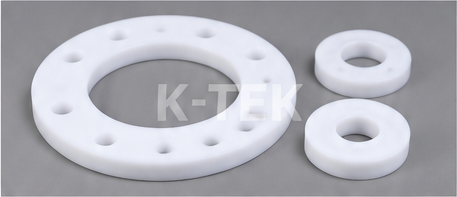
PTFE can be machined into sealing rings,gaskets, washers and custom sealing elements for pumps, valves,chemical-processing equipment and laboratory instruments. Its chemicalresistance and low friction can be helpful in demanding environments. Thedrawing should identify the sealing faces, critical dimensions, mating partsand the media and temperature the component will encounter.
Figure 1. IllustrativeCNC-machined PTFE seals and gaskets. Conceptual image, not a completed customerproject.
Example Two: PTFE Insulating Components
PTFE is used for insulating spacers,sleeves, bushings and supports in electrical, electronic and laboratoryequipment. Its insulating properties can help separate conductive parts whilesupporting accurate assembly. For components with tight positionalrequirements, specify the datum scheme, critical hole locations and theinspection method during quotation review.
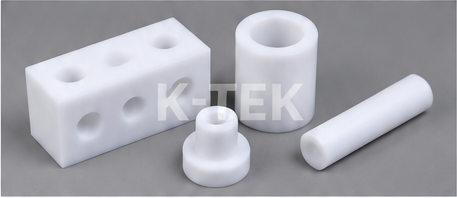
Figure 2.Illustrative PTFE insulating components. Conceptual image, not a certifiedelectrical assembly.
Example Three: PTFE Fluid-Handling Components
Custom PTFE parts may be used influid-handling systems, including valve seats, connectors, nozzles and selectedpump components. Their suitability depends on the fluid, pressure, temperature,mechanical loading and the geometry of the mating components. These operatingconditions should be provided before material and machining requirements arefinalized.
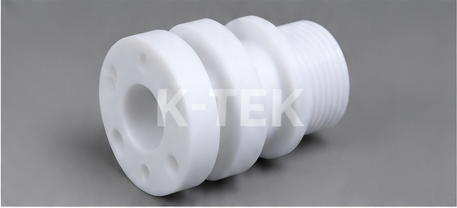
Figure 3.Illustrative CNC-machined PTFE fluid-handling component. Conceptual image, nota validated pressure-containing part.
What to Consider When CNC Machining PTFE
PTFE can be machined by CNC turning andmilling, but its softness and tendency to deform make tooling, fixturing andprocess planning important. Sharp tools, suitable cutting parameters andcontrolled clamping can help limit burrs, surface damage and dimensionalvariation. For thin walls, close tolerances or features that must retain theirshape under load, a trial part and first-article inspection can help verify theprocess.
What to Send for an Engineering Review
Please provide the current 2D drawing and3D model, PTFE grade or filled-material specification, quantity, criticaldimensions and tolerances, surface-finish requirements, mating-part details,and the intended chemical, temperature and mechanical conditions. Flag anysealing faces or dimensions that require first-article verification. Clearinputs help identify process questions before production and support a moreaccurate quotation.
Discuss Your PTFE Component with K-TEK
K-TEK provides custom CNC milling, turningand dimensional inspection for industrial components. To discuss a PTFE orother engineering-plastic project, send the drawings and applicationrequirements to k-teksales8@ktekpart.com. Material suitability, tolerances andinspection documentation can be reviewed for the specific part before an orderis placed.


